
Digital Asset Recovery for Institutions: The Definitive Guide
Updated on
September 3, 2026
Institutional digital asset recovery is the ability to regain control of assets after a wallet is compromised, keys are lost, or infrastructure fails, without depending on the original signing credentials. It restores the assets themselves rather than the ability to sign, which is the distinction that determines whether a loss event is survivable. Most custody stacks have no recovery layer at all.
Why does institutional digital asset custody have no recovery layer?
The industry optimised for prevention and treated recovery as an afterthought. Almost every dollar of security investment in institutional crypto goes into keeping keys safe: hardware security modules, multi-party computation, multisig quorums, air-gapped signing, geographically distributed shards. That work is necessary, and it is also incomplete, because it only answers one question: how do we stop the key from being stolen or misused?
It does not answer the second question, which is the one that matters on the worst day: what happens after prevention fails? When a key is compromised, a signer becomes unavailable, a vendor goes dark, or an exploit drains a wallet, the prevention stack has nothing left to offer. There is no equivalent of a fire suppression system, no automated failover, no defined path back to a safe state. The assets are simply gone or frozen, and the response is manual, slow, and often futile.
This is the gap. In the language of the NIST Cybersecurity Framework 2.0, custody-only solutions cover Identify, Protect, and sometimes Detect. They leave Respond and Recover largely empty. For a bank, a hospital, or a payments network, operating with an empty Respond and Recover column would be considered negligent. In digital assets it is still treated as normal. The result is that the assets under institutional protection are frequently unrecoverable by design, and the people relying on them do not always know it.
Circuit Security exists to fill that gap. Circuit is not a custodian and cannot access, use, or reconstruct your keys. It is the recovery and resilience layer that sits alongside custody, so that when prevention fails, the assets can still be brought home.
What is institutional digital asset recovery?
Institutional digital asset recovery is the process of restoring control over on-chain assets after a failure or compromise event, at a scale and speed that an institution can operate and audit. It differs from consumer-grade recovery in three ways: it must work across many wallets and asset types at once, it must produce an evidence trail for regulators and insurers, and it must not reintroduce the very credential risk it is meant to solve.
Recovery is often confused with two adjacent things it is not. It is not a backup, because a backup preserves a copy of the credential and therefore preserves the ability to sign, not the assets. And it is not insurance, because insurance pays out after the loss is realised, while recovery prevents the loss from being realised in the first place. Recovery is the operational control that acts in the window between the failure and the loss.
To be clear about the limits: Circuit does not take custody, does not store or reconstruct private keys, and does not indemnify against loss. It provides the mechanism that moves assets to safety when the primary control path is broken.
What are the failure modes that require digital asset recovery?
Recovery has to account for the full range of ways institutional assets become compromised or inaccessible, not just theft. The failure modes below are the recurring reasons an institution loses the ability to move its own assets.
Key loss
A private key or seed is destroyed, corrupted, or rendered permanently inaccessible. This includes hardware failure of a signing device, loss of a key shard beyond the recoverable quorum, and the departure or death of the only person who held a critical credential. The assets are intact on-chain but no valid signature can be produced.
Custodian or vendor failure
A third-party custodian, wallet provider, or signing service becomes insolvent, is hacked, suspends withdrawals, or simply goes dark. The institution's assets may be technically recoverable but are trapped behind a counterparty it no longer controls. Vendor concentration turns a single provider's bad day into the institution's bad quarter.
Signer unavailability
A multisig or MPC quorum cannot be assembled when it is needed. Signers are travelling, unreachable, incapacitated, or locked out by their own security controls. The keys exist and are safe, but the transaction cannot be authorised inside the time window that matters.
Infrastructure outage
The signing infrastructure itself is down: a cloud region fails, an HSM is unreachable, a network partition isolates the signing environment, or a software fault blocks transaction construction. The institution is prevented from acting on its own assets by an operational fault rather than a security breach.
Insider action
A privileged individual abuses legitimate access to move assets, or holds them hostage. Because the action uses valid credentials, prevention controls treat it as authorised. Recovery has to assume that the credential itself can turn against the institution.
Exploit or active attack
A smart contract exploit, an approval-drain, a phishing-enabled signature, or a live intrusion begins moving assets out of institutional control. Here the failure mode is adversarial and fast, and recovery has to compete with the attacker for the same funds in real time. This is where incident response and recovery converge.
Across all six, the common thread is the same: prevention has already failed by the time recovery matters. A recovery capability that only works when the keys are safe and the signers are available is not a recovery capability at all.
What does institutional-grade recovery actually require?
A recovery capability that survives contact with a real incident has to meet a specific set of requirements. Consumer seed-phrase recovery meets none of them.
- It must not depend on the compromised credential. If recovery requires the same private key that was lost, stolen, or held hostage, it fails in exactly the scenarios it exists for. Recovery cannot rely on the private keys.
- It must define a destination in advance. Assets have to move to a pre-approved, institution-controlled location. Deciding where funds go during an active incident is how mistakes and insider redirection happen.
- It must operate inside the loss window. For an active exploit, that window is seconds. A process that takes hours of manual coordination will lose the race to the attacker.
- It must scale across the whole estate. Recovery has to cover every wallet, chain, and asset type an institution holds, not a single flagship wallet. Partial coverage is a false sense of safety.
- It must produce evidence. Every recovery action needs an auditable record for regulators, insurers, and internal governance. A recovery you cannot prove is a recovery you cannot rely on.
- It must not expand the attack surface. The recovery system itself must not become a new place to steal keys or a new single point of failure. This is why storing another copy of the credential is the wrong answer.
These requirements are also the foundation of broader operational resilience: the ability of an institution to continue delivering critical operations through disruption. Recovery is the digital-asset-specific expression of resilience.
How does keyless recovery via Automatic Asset Extraction work?
Automatic Asset Extraction (AAE) is the technology behind institutional keyless recovery, meaning recovery that does not depend on your private keys. It uses pre-signed, continuously updated transactions to sweep assets to pre-approved vaults when wallets are compromised or inaccessible, without requiring access to those keys.
The mechanism works because it separates the moment of authorisation from the moment of execution. The institution authorises the recovery path once, in advance, while its keys and signers are fully available. From then on, recovery no longer needs them.
- Define the safe destination. The institution designates one or more pre-approved vaults it controls. These are the only places recovered assets can go. The destination is fixed at setup, which removes the ability for anyone, including an insider, to redirect funds during an incident.
- Generate pre-signed transactions. While keys and signers are available, Circuit generates pre-signed transactions that would move assets from the operational wallets to the safe vaults. These are valid, ready-to-broadcast transactions that require no further signature.
- Keep them continuously updated. Balances, nonces, and asset positions change constantly. Circuit continuously refreshes the pre-signed transactions so they always reflect the current state of the wallets. A stale recovery transaction is a useless one.
- Detect the trigger condition. Circuit monitors for the conditions that mean recovery is warranted: a compromise signal, an inaccessibility event, or an operator-initiated trigger. Detection is what turns a standing capability into an action.
- Broadcast the sweep. When a trigger fires, the relevant pre-signed transactions are broadcast, moving the assets to the pre-approved vaults. Because the transactions were signed in advance, this step needs no live key access and no signer coordination.
- Produce the evidence trail. Every step is logged and attributable, giving the institution a defensible record of what moved, when, and why.
The result is that the assets remain recoverable: they can be brought to safety even when the keys are gone, the signers are unreachable, or an attacker is already inside. Circuit still never holds the private keys, and the institution keeps full control of both the operational wallets and the destination vaults.
Two products are built on this technology. Circuit Recovery brings assets back after loss or failure, using pre-signed transactions to reach a safe vault without live key access. Circuit Response stops an attack in progress: it monitors the mempool and contains attacks in under 2 seconds, which is what allows recovery to win the race against a live exploit. Circuit's third product, Key Backup, is trustless encrypted storage for the key material you fall back on when the wallet stack itself has failed, and it is a separate mechanism from AAE rather than one of the keyless, AAE-powered products.
What regulations are driving institutional recovery requirements?
Regulators have moved decisively toward requiring demonstrable recovery and resilience, not just prevention. The four frameworks below are the ones institutional digital asset operators encounter most often.
- DORA (EU financial entities): digital operational resilience, including tested recovery capabilities, defined recovery objectives, and management of third-party (vendor) concentration risk.
- MiCA (EU crypto-asset service providers): safeguarding of client crypto-assets and operational continuity obligations for CASPs.
- NYDFS Part 500 (New York-regulated financial services): a cybersecurity programme with incident response and business continuity requirements, including recovery from cybersecurity events.
- NIST CSF 2.0 (global voluntary framework): explicit Respond and Recover functions that a prevention-only posture leaves unaddressed.
The through-line across all four is that supervisors no longer accept "we prevent breaches" as a complete answer. They ask what happens when prevention fails, whether the recovery capability has been tested, how quickly assets can be brought back to a safe state, and whether the institution depends on a single vendor whose failure would be unrecoverable. An institution that cannot answer those questions has a compliance gap, not just a security one.
How should you evaluate a recovery capability in a vendor review?
Treat recovery as a distinct capability to be assessed on its own merits, separate from custody and prevention. During a vendor review, ask questions that expose whether the recovery actually works in the failure modes above, not just on paper.
- Does recovery depend on the key or signer? If the answer is yes, it fails in the key-loss, insider, and signer-unavailability scenarios. Insist on recovery that does not rely on the private keys.
- Where do recovered assets go, and who decides? The destination should be pre-approved and fixed, not chosen during an incident. Ask whether an insider could redirect funds mid-event.
- How fast is it, and against what? For active exploits, ask for the containment time. Circuit Response contains attacks in under 2 seconds; a manual process cannot.
- Does it cover the whole estate? Confirm coverage across all wallets, chains, and asset types, not a single wallet demo.
- Is the vendor a custodian? Confirm whether the recovery vendor takes custody or holds keys. Circuit does neither, which means it does not become a new counterparty risk.
- Has it been independently validated? Circuit is backed by the Lloyd's Central Fund, and insurers offer premium discounts of up to 15%. Circuit is SOC 2 attested. Independent validation is the difference between a claim and a capability.
- What evidence does it produce? Ask to see the audit trail a recovery action generates, because that is what satisfies regulators and insurers after the fact.
A useful framing for the whole review is recovery versus backup: if a vendor's answer to "how do we recover?" is really "we keep another copy of the key", they are offering a backup, and a backup is a liability, not a recovery.
What Circuit does not do
Circuit is deliberately narrow, and stating the limits is part of using it correctly.
- Circuit is not a custodian and cannot access, use, or reconstruct your keys.
- Circuit's Recovery and Response never touch your keys, and Circuit Key Backup stores only an encrypted copy that Circuit cannot decrypt and that you control.
- Circuit is not insurance and does not indemnify against loss; it prevents loss from being realised and improves insurability.
- Circuit is not a prevention tool and does not replace HSMs, MPC, or multisig; it operates alongside them for the moment they fail.
- Circuit cannot move assets to a destination the institution has not pre-approved.
Frequently asked questions
What is institutional digital asset recovery?
Institutional digital asset recovery is the ability to restore control of on-chain assets after a compromise, key loss, or infrastructure failure, at institutional scale and with an auditable evidence trail. It preserves the assets rather than the ability to sign, and it must work even when the original keys or signers are unavailable.
Is a private key backup the same as recovery?
No. A backup preserves a copy of the credential, which preserves the ability to sign and also creates another copy to steal or lose. Recovery preserves the assets themselves. Because it does not depend on the credential at all, it works in the scenarios where a backup fails.
Does Circuit Security take custody of assets or hold private keys?
No. Circuit is not a custodian and cannot access, use, or reconstruct your keys. It provides a recovery mechanism that does not rely on the private keys, sweeping assets to institution-controlled vaults using pre-signed transactions, so the institution keeps full control throughout.
How fast can Circuit respond to an active attack?
Circuit Response detects and contains attacks in under 2 seconds by monitoring the mempool and triggering pre-signed recovery transactions. This speed is what allows recovery to compete with a live exploit for the same funds.
Which regulations require a recovery capability?
DORA, MiCA, NYDFS Part 500, and NIST CSF 2.0 all push institutions toward demonstrable recovery and operational resilience rather than prevention alone. NIST CSF 2.0 names Respond and Recover as explicit functions, and DORA requires tested recovery capabilities and management of vendor concentration risk.
Want to keep up to date with Circuit? Sign up below
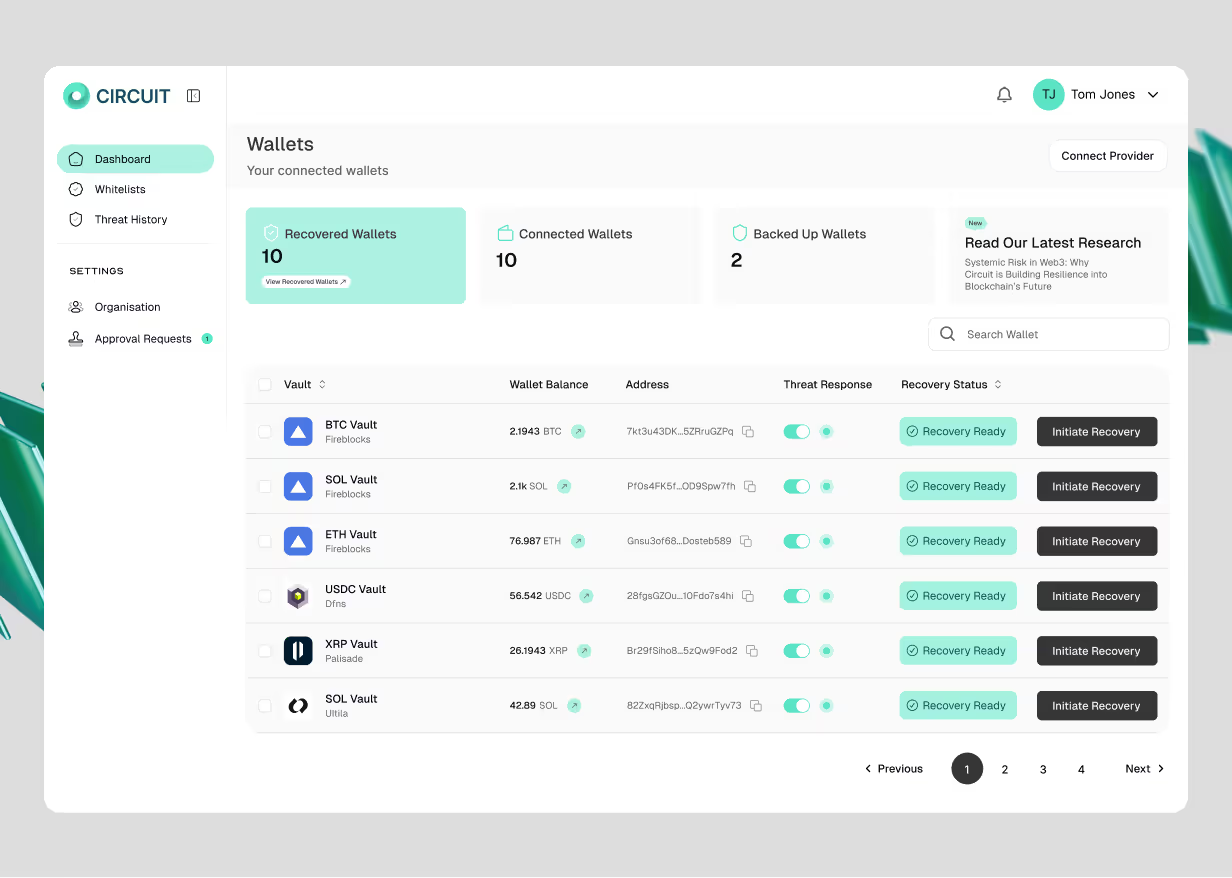
Built by experts who’ve made digital assets safer, and now, recoverable
We believe asset recoverability is table stakes for the next era of digital assets.