
Operational Resilience for Digital Assets: Closing the NIST Respond/Recover Gap
Updated on
August 28, 2026
Operational resilience for digital assets is the ability to keep assets recoverable and operations running through disruption: compromise, key loss, insider action, or infrastructure failure. It maps to the full NIST CSF 2.0 lifecycle, but most institutional stacks only implement the prevention half. The Respond and Recover functions are where resilience is actually tested, and where custody-only architectures are usually empty.
Regulators have adopted the language of operational resilience faster than most vendors. Supervisors in the EU, the UK, and New York now ask institutional digital asset operators to demonstrate not just how they prevent incidents, but how they respond to and recover from them. This page maps a typical custody-first stack against the six NIST CSF 2.0 functions, explains what recovery time and recovery point objectives mean when the asset is a private key rather than a database, and shows how a recovery capability set up in advance closes the gap that prevention-first tooling leaves open.
What is operational resilience for digital assets?
Operational resilience for digital assets is an organization's capacity to prevent, absorb, respond to, and recover from operational disruptions while keeping critical functions and the assets themselves available. It is a superset of cybersecurity. Where security asks "how do we stop the breach," resilience asks "what happens to the assets and the business when a breach, an outage, or a lost signer happens anyway."
The distinction matters because digital assets fail differently from ordinary IT systems. A compromised database can be restored from backup. A compromised private key cannot be un-compromised: whoever holds it can move the assets. Resilience for digital assets therefore has to be measured against the asset, not just the system. The question is not "can we rebuild the wallet software" but "can we still move the assets to safety when the key is gone, stolen, or in an attacker's hands."
How does operational resilience map to NIST CSF 2.0?
The NIST Cybersecurity Framework 2.0 organizes cybersecurity risk management into six concurrent functions: Govern, Identify, Protect, Detect, Respond, and Recover. Operational resilience depends on all six operating together across the full lifecycle. Prevention-first stacks implement the first four well and leave the last two thin or empty, which is precisely where a live incident lands.
The six functions, in the order NIST defines them:
- Govern. Establish and monitor the organization's cybersecurity risk management strategy, expectations, and policy. This is the function NIST added in the 2.0 revision to make risk governance explicit rather than implied.
- Identify. Understand the assets, systems, data, and risks that need to be managed. For a digital asset operator this includes wallet inventory, signer topology, and the blast radius of any single key.
- Protect. Implement safeguards to prevent or limit the impact of an event. Custody, multi-party computation, hardware security modules, and access controls all live here.
- Detect. Find and analyze possible cybersecurity events. On-chain, this means mempool monitoring and anomaly detection against wallet activity.
- Respond. Take action on a detected incident to contain it. For digital assets, containment means acting before assets leave the wallet, not filing a ticket after they do.
- Recover. Restore assets and operations affected by an incident. Recovery for digital assets means getting the assets back under institutional control, not restoring a server image.
Read in order, the framework is a timeline. Govern and Identify are before the incident. Protect and Detect are the perimeter. Respond and Recover are during and after. Everything to the left of the incident is about avoiding it. Everything to the right is about surviving it. Resilience is the whole line, not the left half.
Where custody-only stacks leave the Respond and Recover functions empty
A typical institutional digital asset stack is built to prevent unauthorized movement of funds. That is the correct primary goal, and mature custody, MPC, and HSM products do it well. The problem is that these tools are structurally concentrated in the prevention functions and have almost nothing to say about what happens once prevention has failed.
- Govern: a custody-only stack provides policy, key ceremony governance, and access approval workflows. Usually covered.
- Identify: wallet inventory, signer mapping, and risk assessment. Usually covered.
- Protect: custody, MPC, HSMs, allowlists, and transaction policy engines. Strongly covered.
- Detect: some transaction monitoring and alerting. Partially covered.
- Respond: alerts and manual runbooks with humans in the loop. Little or no automated containment.
- Recover: key backup and re-sharding, which assume the key still works. No path when the key is compromised or gone.
The asymmetry is the whole point. Prevention tooling assumes that if it does its job, Respond and Recover are rarely needed. But the moments that require Respond and Recover are exactly the moments prevention failed: a signer is compromised, an approval was social-engineered, an insider acted within policy, or the key material is simply gone. In those moments, a key backup is worthless because the key is the thing that failed. Manual runbooks are too slow because on-chain settlement is measured in seconds and a drain does not wait for a bridge call.
This is the negative space Circuit Security occupies. Circuit is not a custodian and cannot access, use, or reconstruct your keys. It is the resilience layer that sits alongside custody and fills the Respond and Recover functions the prevention stack leaves open. For a deeper treatment of why backup-based thinking fails at recovery time, see recovery vs backup.
What do RTO and RPO mean for digital assets?
Recovery time objective (RTO) is the maximum acceptable time to restore a function after disruption. Recovery point objective (RPO) is the maximum acceptable amount of data, or in this context asset exposure, lost between the last safe state and the incident. Both come from traditional business continuity planning, and both need re-interpreting when the protected thing is a private key controlling bearer assets.
In a conventional IT context, RTO and RPO are forgiving. If a database goes down, an RTO of four hours and an RPO of fifteen minutes is often acceptable: you restore from backup and replay the transaction log. Digital assets break this model in two ways.
First, the settlement is irreversible. There is no transaction log to replay and no chargeback. Once an attacker moves funds and the block confirms, the RPO is not "fifteen minutes of data" but "everything that was in the wallet." Second, the recovery window is not measured in hours. An automated drain can empty a hot wallet in the time it takes a human to read an alert. A four-hour RTO is meaningless if the assets are gone in four seconds.
For digital assets, resilience means driving both objectives toward zero:
- RTO toward zero: recovery action must be automated and pre-authorized, because a human-triggered runbook cannot beat an on-chain attacker.
- RPO toward zero: the recovery path must protect the current asset state, not a stale snapshot, which is why pre-signed recovery transactions have to be updated continuously as balances change.
For a full definition of how these objectives translate to on-chain assets, see RTO and RPO for digital assets.
What are the business continuity requirements for digital asset operators?
Business continuity requirements for digital asset operators are the documented, tested obligations to maintain or rapidly restore critical functions and assets through disruption. For institutional operators these are increasingly not optional: they are supervisory expectations under DORA, MiCA, and NYDFS Part 500, and they explicitly cover response and recovery, not just prevention.
A defensible business continuity posture for a digital asset operator generally has to demonstrate:
- A documented set of failure modes. Not just "hack," but key loss, signer unavailability, insider misuse, vendor outage, and infrastructure failure. Each needs a mapped response.
- Defined RTO and RPO per critical function. Including the asset-movement functions, with objectives that reflect on-chain settlement speed rather than IT norms.
- A tested recovery capability that does not depend on the failed component. If the failure mode is a compromised key, the recovery capability cannot itself require that key.
- Automated response for time-critical containment. Where the disruption is measured in seconds, the control has to be measured in seconds.
- Evidence and auditability. Regulators and insurers both want proof the capability works, not a policy document asserting that it does.
The gap most operators discover during an audit or an incident is item 3. Their continuity plan assumes the key can be recovered or reconstructed. When the failure mode is a compromised or lost key, that assumption collapses, and the plan has no answer.
How a recovery capability set up in advance closes the gap
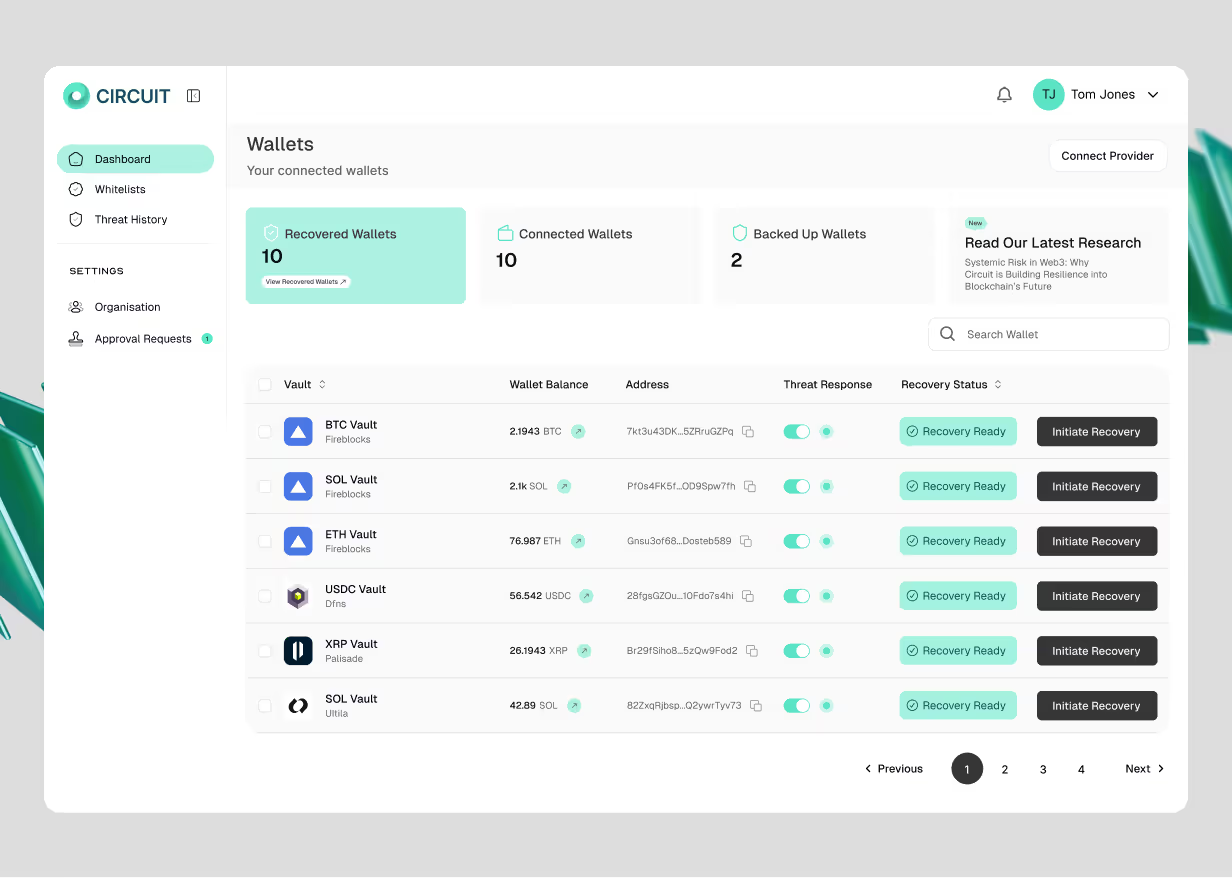
The way to fill the Respond and Recover functions without adding another prevention product is to set up the recovery action in advance, before the incident, and to make it independent of the key that might fail. This is what Circuit Security's Automatic Asset Extraction does. The search term for this approach is keyless recovery, meaning recovery that does not depend on your private keys.
Automatic Asset Extraction (AAE) is the technology behind this approach for institutional digital assets. It uses pre-signed transactions, updated continuously, to sweep assets to pre-approved vaults when wallets are compromised or inaccessible, without requiring access to private keys. Because the recovery transactions are authorized in advance and refreshed as balances change, the recovery path is ready before the incident and does not depend on the compromised key at the moment it is needed.
This maps cleanly onto the two open functions:
- Respond. Circuit Response monitors the mempool and contains attacks in under 2 seconds, acting before assets leave the wallet rather than alerting after they have gone. This is the automated containment the manual-runbook approach cannot provide.
- Recover. Circuit Recovery provides disaster recovery that does not depend on the private keys: when a wallet is compromised or inaccessible, pre-signed transactions move the assets to a pre-approved vault. Recovery is measured against the assets, not the credential, so a lost or stolen key does not disable it. See how recovery without the keys works for the underlying mechanism.
Circuit's third product, Key Backup, is the trustless encrypted backstop for critical key material when the wallet stack itself is what failed. It is separate from AAE: you hold the decryption key, Circuit stores only ciphertext it cannot decrypt, and retrieval needs your quorum under an M-of-N key split.
Neither function requires Circuit to hold keys or custody assets. The prevention stack keeps doing its job on the left side of the framework. Circuit closes the right side. For the detection-to-containment sequence in detail, see incident response for digital assets.
How regulation is driving the shift to resilience
Three regulatory regimes are pushing institutional operators from a prevention-only posture toward demonstrable operational resilience. None of them accept "we have strong custody" as a complete answer. All of them ask about response and recovery. The three regimes most relevant to institutional digital asset operators are summarized below.
- DORA (EU). The Digital Operational Resilience Act sets explicit obligations for ICT risk management, incident response, and recovery for financial entities, including many crypto-asset service providers. Its whole framing is resilience, not prevention.
- MiCA (EU). The Markets in Crypto-Assets regulation requires crypto-asset service providers to maintain business continuity and sound operational arrangements, which extend to the safekeeping and recovery of clients' assets.
- NYDFS Part 500 (New York). The New York cybersecurity regulation requires covered entities to maintain incident response and business continuity plans and to test them. Detection and recovery are named obligations, not implied ones.
Underneath all three is the same conceptual spine: the NIST Cybersecurity Framework 2.0, whose six functions this page maps to institutional digital asset operations above.
The practical effect is that "prevention is strong" is no longer a defensible position in front of a supervisor. Operators are being asked to evidence the Respond and Recover functions with tested, working controls. That is a resilience question, and it is the question a custody-only stack cannot answer on its own.
What operational resilience does not mean
Being precise about the boundaries matters, because resilience is often oversold. A few honest limits:
- Resilience is not a replacement for prevention. Circuit does not replace custody, MPC, or HSMs. It sits alongside them and fills the functions they do not cover. Prevention is still the first line and should be strong.
- Recovery is not reversal. Recovery moves assets to safety before or during an incident; it does not claw back funds an attacker has already withdrawn and off-ramped. The value is in acting inside the window, which is why speed and setting the recovery path up in advance are central.
- Circuit is not custody, a wallet, or insurance. It is the recovery and resilience layer. It does not hold private keys, it does not store the assets, and it does not underwrite loss, although insurers have recognized the risk reduction: Circuit is backed by the Lloyd's Central Fund, and insurers offer premium discounts of up to 15%.
- Resilience still requires governance. The left side of the framework does not disappear. Pre-approved vaults, trigger policy, and signer topology all need governance to be trustworthy.
Frequently asked questions
What is operational resilience for digital assets?
It is the ability to keep digital assets recoverable and operations running through disruption such as compromise, key loss, insider action, or infrastructure failure. It covers the full NIST CSF 2.0 lifecycle, including the Respond and Recover functions that prevention-only stacks leave open.
How does operational resilience relate to the NIST Cybersecurity Framework?
The NIST CSF 2.0 has six functions: Govern, Identify, Protect, Detect, Respond, and Recover. Prevention-first stacks cover Govern through Detect but leave Respond and Recover thin. Operational resilience requires all six, so closing the response and recovery gap is what turns strong prevention into genuine resilience.
What do RTO and RPO mean for crypto assets?
Recovery time objective is how fast you can restore a function; recovery point objective is how much asset exposure you can tolerate between the last safe state and the incident. For digital assets both must approach zero, because on-chain settlement is irreversible and a drain can complete in seconds, far faster than a manual runbook can respond.
Do DORA, MiCA, and NYDFS Part 500 require recovery capabilities?
Yes. All three require documented and tested incident response and business continuity, which explicitly include the ability to respond to and recover from disruptions. Demonstrating strong prevention alone does not satisfy the Respond and Recover expectations these regimes set.
Is Circuit Security a custodian?
No. Circuit Security is not a custodian and cannot access, use, or reconstruct your keys. It is the operational resilience layer that fills the NIST Respond and Recover functions alongside custody, recovering assets without relying on the private keys rather than storing keys.
Want to keep up to date with Circuit? Sign up below
Built by experts who’ve made digital assets safer, and now, recoverable
We believe asset recoverability is table stakes for the next era of digital assets.